Thursday, October 29, 2015

Wednesday, October 28, 2015
Survey Questions
1) Do you use some sort of social media regularly?
2) How often do you check social media throughout the day?
3) On social media, how often do you see brands or company names in posts made by contacts on social media?
4) Do you feel that these posts motivate you to purchase something made by a company?
5) Do you feel that most often seeing a company name servers as a reminder or motivation to buy a product?
2) How often do you check social media throughout the day?
3) On social media, how often do you see brands or company names in posts made by contacts on social media?
4) Do you feel that these posts motivate you to purchase something made by a company?
5) Do you feel that most often seeing a company name servers as a reminder or motivation to buy a product?
Monday, October 26, 2015
Research Questions and Reading Comparison
Questions
1) What is the main purpose of student use of social media and what is the impact of this use on the effectiveness of advertisements? Breaking down the use of social media to connect with peers, keep up with news / events, or for entertainment purposes. Comparing these priorities to how students react to advertisements that are primarily, funny, informative, serious, or involve advertising based on celebrity appearance or a peer connection.
2) While using social media, how to students react to certain types of media and how do they react to ads that follow a similar pattern? Are students more likely to create or spread funny posts, serious posts, etc.? How does the likelihood of a student to be involved with certain types of media impact how they react to advertisements that follow a similar pattern?
In order to gather information to help answer these questions, I would ask students questions designed to help inform me about how they would react to each different focus of social media. This would be done through asking them directly if they are more likely to spread something they consider funny, serious, informative, etc.. To help understand how these preferences impact the effectiveness of advertisements, I would ask them how they would classify the last advertisement they remember seeing on social media and how they reacted to that advertisement. In addition, I would ask about the last effective and ineffective advertisement they can remember from social media. These questions could be posed in a mixture of multiple choice and short answer format. Multiple choice would allow me to narrow down the use of social media by students and how they prioritize different aspects of social media while short answer would help gather information about reactions to different advertisements.
Comparison
Although both articles cover economics and bagels, and do so in an academic nature intended to inform the reader, they cover to different subjects entirely in their actual content. The reading from Freakonomics covers how a bagel company can be used to examine the moral fiber of corporations and the association of this knowledge with white collar crime. The paper by Levitt by contrast analyzes profit maximizing choices that are made by firms based on the example of the same bagel and donut company. Although the papers have different focuses, they use the same data and they both set out to inform the reader about a larger issue that can be distilled into a pure form and related to concrete examples given by the simple bagel business that Feldman started.
In terms of organization, the paper by Levitt follows the IMRaD structure more closely, while the reading from freakonomics is less formally structured. Levitt uses a clearly labelled abstract, introduction, and gives models and examples of data and how it relates to the issue he is exploring. In contrast, the freakonomics reading does all of the same things, except providing literal charts analyzing the data. Both readings offered an abstract or point, provided a background, and then used data from the bagel business Feldman ran in order to relate an abstract or general idea to concepts and proofs provided by a real world business.
1) What is the main purpose of student use of social media and what is the impact of this use on the effectiveness of advertisements? Breaking down the use of social media to connect with peers, keep up with news / events, or for entertainment purposes. Comparing these priorities to how students react to advertisements that are primarily, funny, informative, serious, or involve advertising based on celebrity appearance or a peer connection.
2) While using social media, how to students react to certain types of media and how do they react to ads that follow a similar pattern? Are students more likely to create or spread funny posts, serious posts, etc.? How does the likelihood of a student to be involved with certain types of media impact how they react to advertisements that follow a similar pattern?
In order to gather information to help answer these questions, I would ask students questions designed to help inform me about how they would react to each different focus of social media. This would be done through asking them directly if they are more likely to spread something they consider funny, serious, informative, etc.. To help understand how these preferences impact the effectiveness of advertisements, I would ask them how they would classify the last advertisement they remember seeing on social media and how they reacted to that advertisement. In addition, I would ask about the last effective and ineffective advertisement they can remember from social media. These questions could be posed in a mixture of multiple choice and short answer format. Multiple choice would allow me to narrow down the use of social media by students and how they prioritize different aspects of social media while short answer would help gather information about reactions to different advertisements.
Comparison
Although both articles cover economics and bagels, and do so in an academic nature intended to inform the reader, they cover to different subjects entirely in their actual content. The reading from Freakonomics covers how a bagel company can be used to examine the moral fiber of corporations and the association of this knowledge with white collar crime. The paper by Levitt by contrast analyzes profit maximizing choices that are made by firms based on the example of the same bagel and donut company. Although the papers have different focuses, they use the same data and they both set out to inform the reader about a larger issue that can be distilled into a pure form and related to concrete examples given by the simple bagel business that Feldman started.
In terms of organization, the paper by Levitt follows the IMRaD structure more closely, while the reading from freakonomics is less formally structured. Levitt uses a clearly labelled abstract, introduction, and gives models and examples of data and how it relates to the issue he is exploring. In contrast, the freakonomics reading does all of the same things, except providing literal charts analyzing the data. Both readings offered an abstract or point, provided a background, and then used data from the bagel business Feldman ran in order to relate an abstract or general idea to concepts and proofs provided by a real world business.
Thursday, October 22, 2015
Big Stuff, Small Stuff Analysis
Through reading Big Stuff, Small Stuff, I learned that there are many key differences between an IMRaD report and the typical argument based research paper that I have written in the past. One of the first differences is the tone of an IMRaD paper, which is more formal. Another key difference is the type of research and analysis that you do for an IMRaD paper as opposed to a typical argument based research paper. I've never had to write a formal report over information that I've gathered myself, although I have had experience in drawing conclusions from polls and personal research in the past. The structure of an IMRaD report is also very different from a typical argument based paper because you are analyzing raw information and creating a source similar to what a student may have previously used to write their own argument based research paper. This different purpose in writing an IMRaD report means that a different structure is the best way to effectively communicate the ideas behind the report. The structure itself means that the writer needs to include an abstract, introduction, methodology statement, and also graphs and other assessments of data in order to thoroughly prove a point. The use of multiple ways to communicate information in one report is something that is entirely new to my experience with writing reports and in addition to the different structuring sets this assignment apart from previous work that I have done.
Tuesday, October 6, 2015
Speech Outline
Alexander Masada
Corey
RHET:1030:0055
Speech
Outline
Introduction
Hook
- Did you know that the University of Iowa has over 31,000 students currently
attending classes, and that of those 31,000 students, over 5,000 were admitted
as Freshmen this semester?
Thesis -
The University of Iowa uses Ethos and Pathos in advertisements used to attract
students. The University incorporates Ethos and Pathos to distinguish itself by
presenting the stories of credited alumni used to both inspire students and
build faith in the success story of previous students at Iowa and through
simple and inclusive slogans.
Overview
-
I will focus on how the University brands itself through online and print
advertisements and how these ads fit into the application of Ethos and Pathos
through the aspects mentioned above. Overall advantage of the advertising
scheme at the University is building credibility in the success of alumni and
connecting students to that success through slogans and other inclusive
branding devices. University differentiates itself by citing the success of
Alumni and incorporating hopeful students into that success, introduces the
idea of a Hawkeye Network and recognition.
Body
Transition
–
Idea of the good work ethic associated with the Midwest, example of how
employers (PWC, CLA) have mentioned this to one of my classes. The idea spread
through a history of respected alumni and success associated with attendance of
schools like Iowa.
Alumni
success / placement
1. Topic
Sentence / Focus : The University of Iowa places a strong emphasis on the
success of Alumni and uses Alumni success stories to help build trust with
students through advertisements.
2. Example
: (Ad 1, Alumni meet) Many chances to meet Alumni are offered through the
University of Iowa and are advertised regularly to current students. These
opportunities to meet successful alumni are also communicated to prospective
students who have relevant areas of interest.
3. Synthesis
: The opportunities to meet alumni offered by the University of Iowa are
valuable for students and help to inspire confidence in the applicability of
programs of study through the University. Being able to talk to someone who has
completed a path similar to the path you plan to take at Iowa and seeing where
they are helps to make the goals you hope to meet more tangible and manageable.
The ability to have a real conversation with someone who can explain and expand
on answers to questions you ask is invaluable and builds confidence in an idea
in a way no other experience can.
Slogans
1. Topic
Sentence / Focus : The University of Iowa applies the credibility it builds with
students through Alumni success stories to the students themselves through the
use of slogans intended to help students feel a personal connection with Alumni
success.
2. Example
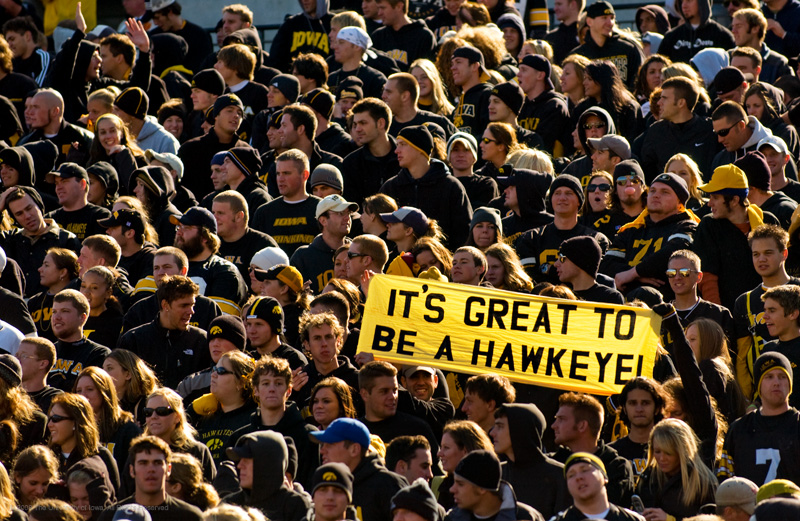
: “Iowa will change you, you will change the world” and “It’s great to be a
Hawkeye” quote slides showing two slogans that are meant to connect students to
the history of success and also the network of Hawkeye Alumni.
3. Synthesis
: This slogan (addressing audience, quote 1) is intended to help make you feel
included in the success associated with the University of Iowa. The idea that
Iowa will change you and that you will then change the world connects attendance
at the University of Iowa with success in a broad field of future careers. This
statement is reinforced by the previously mentioned trust in the University of
Iowa built through examples of alumni success. This second slogan (addressing
audience, quote 2) reinforces the connection of students to the diverse alumni
network that is a result of attending Iowa. The slogan is intended to form a
mutual feeling of Hawkeye pride between alumni of the University of Iowa which
can be a valuable advantage in the competitive workforce.
Differentiation
from the crowd
1. Topic
Sentence / Focus: The University of Iowa uses stories of Alumni success and
inclusive slogans in order to form a brand that stands out from others schools through
a history of placement and achievement.
2. Example
: Advertising of certain schools at the University are emphasized. For example,
the University prioritizes advertisement of the college of business which
consistently ranks as a top school in the nation and was recently ranked #1
best for your money and #2 best in finance, worldwide, according to Financial
Times.
3. Synthesis
: The University makes sure to differentiate itself through the emphasis of
areas of study where Hawkeyes excel. This helps draw more students from across the
country and around the world into the programs offered at Iowa. An example of
the powerful draw of the college of business is the high numbers of foreign and
out of state students that attend classes at Tippie. The fact that Iowa can
draw out of state students to the college of business in spite of higher
tuition rates is a great example of the success of advertising by the
University.
Conclusion
Summary
- The
University of Iowa is an institution that connects itself to students through
stories of success, a focus on creating a network, and distinction by helping
students see that they can perform to meet examples of achievement that they
see in others.
Thesis
restated - The appeals of Ethos and Pathos in
University of Iowa advertisements help to draw in potential students by
building credibility with success stories, creating a feeling of purpose and
acceptance through slogans, and distinguishing the University by showcasing
achievement.
Ad
Sources
1. http://itsnt774.iowa.uiowa.edu/be-remarkable-archive/portfolio/print-ads/pdf/ConnectionsNIACC.pdf

Wednesday, September 30, 2015
Speech Proposal
For my speech, I will be analyzing advertisements used by the University of Iowa. I chose the University because I have lived both in and near Iowa City for my entire life and the University has been as much a part of my life as any local brand or company could be. Living around the University has meant exposure from an early age to University advertising and I am interested in how the University builds advertisements to effectively reach the potential student audience.
For my analysis, I have chosen print and video advertisements for the University. Many of these advertisements focus on the diversity and forward thinking attitude associated with the University of Iowa campus. For comparison, I will analyze advertisements from Iowa State and the University of Northern Iowa to help highlight differences and find common ground between their advertisement strategies.
The University of Iowa uses primarily logos and pathos in order to attract and retain students in the various programs of study offered at Iowa. I have found that primarily logos and pathos are used through the analysis of the print and video ads that I have found. Many of the advertisements focus on Iowa being a good step forward for a student's career and any that do not focus on the purpose of Iowa as the next step in education focus on the concept of the Hawkeye Community. The advertisement of Iowa as a productive step forwards in education is a specific example of the use of logos or logic. For example, a quote from a picture on the U of I admission site states,"Iowa will change you, you will change the world". This quote is meant to demonstrate that Iowa is an essential part of getting students from where they are now to where they want to be. The quote that I chose above can also be used as an example of an appeal to Pathos because it appeals to the hopes and aspirations of incoming students as a part of attracting them to Iowa.
Throughout my speech, I plan to display relevant advertisements and explain how they break down into different aspects of the rhetorical triangle. Whether I am comparing two advertisements or just showing and analyzing one, I plan to have content relevant to my presentation on the projector at all times. I will likely not play entire video advertisements but rather show pictures of video advertisements that are relevant to my presentation which will help condense information.
For my analysis, I have chosen print and video advertisements for the University. Many of these advertisements focus on the diversity and forward thinking attitude associated with the University of Iowa campus. For comparison, I will analyze advertisements from Iowa State and the University of Northern Iowa to help highlight differences and find common ground between their advertisement strategies.
The University of Iowa uses primarily logos and pathos in order to attract and retain students in the various programs of study offered at Iowa. I have found that primarily logos and pathos are used through the analysis of the print and video ads that I have found. Many of the advertisements focus on Iowa being a good step forward for a student's career and any that do not focus on the purpose of Iowa as the next step in education focus on the concept of the Hawkeye Community. The advertisement of Iowa as a productive step forwards in education is a specific example of the use of logos or logic. For example, a quote from a picture on the U of I admission site states,"Iowa will change you, you will change the world". This quote is meant to demonstrate that Iowa is an essential part of getting students from where they are now to where they want to be. The quote that I chose above can also be used as an example of an appeal to Pathos because it appeals to the hopes and aspirations of incoming students as a part of attracting them to Iowa.
Throughout my speech, I plan to display relevant advertisements and explain how they break down into different aspects of the rhetorical triangle. Whether I am comparing two advertisements or just showing and analyzing one, I plan to have content relevant to my presentation on the projector at all times. I will likely not play entire video advertisements but rather show pictures of video advertisements that are relevant to my presentation which will help condense information.
Monday, September 28, 2015
Advertisement Analysis
http://admissions.uiowa.edu/sites/default/files/slide16.jpg
The advertisement that I chose comes from the University of Iowa. The University of Iowa is one of the top public research universities in the nation, and attracts an international student body. The advertisement that I chose to analyze is an image from the admissions page of the University of Iowa website and says, "Iowa will change you, you will change the world". The University of Iowa is identifying itself as a positive and proactive step forwards in life for potential students, saying that through experiences at Iowa students can pursue their interests in meaningful ways. The purpose of this advertisement is to communicate to students that by attending the University of Iowa, they will be gaining a better experience than they could at a competing school. The advertisement conveys this message through logos and pathos. The words on the advertisement are an example of logos used to convey the idea, but what the words say is what engages pathos. By stating that students can change the world using experiences gained at the University, the advertisement engages pathos and makes students think ahead about how their time at the university can help them pursue their ambitions in the real world. Through this combination of logos and pathos, superimposed over a picture of the Old Capital, a symbol of the University, I believe that this is an effective advertisement in connecting Iowa with an image of success beyond a student career.
The advertisement that I chose comes from the University of Iowa. The University of Iowa is one of the top public research universities in the nation, and attracts an international student body. The advertisement that I chose to analyze is an image from the admissions page of the University of Iowa website and says, "Iowa will change you, you will change the world". The University of Iowa is identifying itself as a positive and proactive step forwards in life for potential students, saying that through experiences at Iowa students can pursue their interests in meaningful ways. The purpose of this advertisement is to communicate to students that by attending the University of Iowa, they will be gaining a better experience than they could at a competing school. The advertisement conveys this message through logos and pathos. The words on the advertisement are an example of logos used to convey the idea, but what the words say is what engages pathos. By stating that students can change the world using experiences gained at the University, the advertisement engages pathos and makes students think ahead about how their time at the university can help them pursue their ambitions in the real world. Through this combination of logos and pathos, superimposed over a picture of the Old Capital, a symbol of the University, I believe that this is an effective advertisement in connecting Iowa with an image of success beyond a student career.
Subscribe to:
Posts (Atom)